
What Is Digital Marketing? Skills, Jobs and Career Opportunities in 2026
In 2026, what is digital marketing if not the heartbeat of modern commerce? It uses online channels, data, and technology to attract and keep customers worldwide. Businesses use these tools to build strong connections, driving growth and loyalty.
This guide covers the whole customer journey, from finding the audience to keeping them. You’ll learn how to optimise your approach to creating content and analysing its performance. It’s crucial for anyone in India, whether you’re a student or a professional.

What Is Digital Marketing
We’ll look at key digital marketing skills for success in a competitive world. You’ll find out about different digital marketing jobs and how to build a lasting digital marketing career. We also offer tips for digital marketing for beginners to help you start in the Indian market.
Key Takeaways
- Digital promotion uses online channels to build customer relationships.
- Mastering data analytics helps you optimise campaigns for better results.
- Diverse career paths exist within the evolving Indian tech sector.
- Practical experience remains the best way to develop professional expertise.
- Continuous learning ensures you stay ahead in this fast-paced industry.
What Is Digital Marketing
Understanding digital marketing is key to navigating the online world. It uses internet-connected devices to promote products or services to a specific audience.
Digital marketing explained in simple terms
It’s like a digital chat between a brand and its potential customers. Instead of billboards or newspaper ads, businesses use websites, social media, and search engines. They reach people where they spend most of their time.
Digital marketing lets you send the right message to the right person at the right time. By using data, companies can show ads to people who are really interested in what they offer.
How online marketing differs from traditional marketing
The main difference is the ability to track and adjust strategies in real-time. Traditional methods like TV or print media often reach a wide, untargeted audience. Online marketing gives precise control over who sees your content.
The table below shows the main differences between these two approaches:
| Feature | Traditional Marketing | Online Marketing |
| Targeting | Broad and general | Highly specific |
| Measurement | Difficult to track | Real-time analytics |
| Cost | High entry barrier | Flexible budgets |
Where you encounter digital marketing in everyday life
You meet these strategies every day, often without noticing. Every time you search for a solution or browse your favourite apps, you’re engaging with a digital world designed to grab your attention.
Search results, social media, email and mobile applications
When you search online, the results are often influenced by SEO. The sponsored posts on your social media feeds are tailored to your interests and browsing history.
Email newsletters and mobile app notifications also keep you informed. They offer updates and content that match your preferences.
Practical example: how an Indian business reaches a target customer online
Imagine a local organic grocery store in Bengaluru wanting to grow. By using what is digital marketing, the owner can target health-conscious residents in specific areas on social media.
The store might use a search ad to appear when someone searches for “organic food near me.” Once a customer visits their website, they can capture an email address for weekly discounts. This integrated approach keeps the brand in mind, showing the importance of online marketing for growth.
How Digital Marketing Works from Reach to Conversion
You can turn casual browsers into loyal clients by mastering the digital marketing funnel. Understanding what is digital marketing is more than just posting on social media. It’s a strategic process of guiding people through a journey.
Identifying a target audience and customer needs
Success starts with knowing who your ideal customer is and what problems they face. You must research their pain points to make sure your messaging hits home.
By focusing on a clear audience, you avoid wasting resources. This step ensures every action is based on real human needs, not guesses.
Creating useful content and persuasive offers
Once you know your audience, provide value through quality content. Whether it’s a blog post or a video, it should solve a problem or answer a question.
Pairing this content with a persuasive offer is key. A strong offer gives users a reason to take the next step, like signing up for a newsletter.
Choosing the right digital channels for each stage
The right platform depends on where your customer is in their decision-making. Align your message with the user’s intent at every touchpoint.
Awareness, consideration, conversion and retention
- Awareness: Use social media or search engines to introduce your brand to new people.
- Consideration: Provide detailed guides or webinars to help users evaluate your solution.
- Conversion: Use targeted ads or email sequences to encourage a final purchase.
- Retention: Engage existing customers with loyalty programmes to encourage repeat business.
Measuring clicks, leads, sales and customer lifetime value
Data is crucial for any effective strategy. By tracking key metrics, you can see which parts of your campaign work and which need tweaking.
Performance marketing uses these insights to optimise budgets and improve returns. Focus on metrics that impact your bottom line, like the total value a customer brings over their lifetime.
| Metric | Purpose | Focus |
| Clicks | Traffic volume | Interest |
| Leads | Potential interest | Engagement |
| Sales | Revenue | Conversion |
| CLV | Long-term value | Retention |
Example customer journey for an online coaching business
Imagine you run an online coaching business in India. A potential student might first discover your brand through an informative Instagram reel about career growth.
They then visit your website to read a free case study, which builds trust. After they sign up for your email list, you send them helpful tips, eventually leading them to purchase your premium course.
By applying performance marketing principles, you track how many people clicked the ad, how many signed up, and how many enrolled. This data helps refine your approach, ensuring you attract and retain students effectively.
Why Digital Marketing Matters in 2026
Businesses that ignore the digital shift in 2026 risk losing their relevance to modern Indian shoppers. The way people interact with brands has changed. Online marketing is now essential for any successful organisation. You must understand these shifts to remain competitive in a crowded marketplace.
How Indian consumers discover and compare businesses online
Today, the journey of an Indian consumer almost always begins with a search query. Whether looking for a local restaurant or a new smartphone, people rely on digital touchpoints to gather information. They compare prices, read peer feedback, and evaluate brand reputation before making a single purchase.
Why businesses need measurable marketing investment
Digital channels provide precise data on every rupee spent. You can track exactly how many people saw your ad, clicked on your link, and completed a transaction. This level of transparency allows companies to optimise their budgets for maximum return on investment.
| Metric Type | Traditional Marketing | Digital Marketing |
| Reach Tracking | Estimated/Broad | Precise/Individual |
| Cost Control | Fixed/High | Flexible/Scalable |
| Feedback Loop | Delayed | Real-time |
The importance of mobile-first customer experiences
Most Indians access the internet primarily through their smartphones. If your website or content is not optimised for mobile devices, you are effectively closing your doors to the majority of your audience. A mobile-first approach ensures that your brand remains accessible, fast, and user-friendly on smaller screens.
How local businesses compete with larger brands
Digital tools have levelled the playing field for small enterprises in India. You no longer need a massive budget to reach your target audience effectively. By focusing on specific geographic areas, smaller shops can outshine national chains through better engagement.
Local search, reviews, maps and WhatsApp communication
Visibility on Google Maps and local search results is a game-changer for neighbourhood businesses. Encouraging satisfied customers to leave positive reviews builds instant trust with new prospects. Furthermore, using WhatsApp for direct communication allows you to provide personalised service that builds long-term loyalty.
Privacy, consent and responsible use of customer data
As digital adoption grows, so does the need for ethical data practices. You must prioritise user consent and protect customer information to maintain brand integrity. Building a digital marketing career today requires a deep understanding of these privacy standards, as consumers now demand transparency and security in every interaction.
Major Areas of Digital Marketing You Should Know
Digital marketing lets you reach your audience at every step. It’s about using different channels to boost visibility, engagement, and sales. This way, you can create a strategy that works well over time.
Search engine optimisation for long-term visibility
SEO helps your website show up more in search results. It’s a long-term effort that brings more visitors to your site over time.
Keyword research, technical SEO, content and link building
Good SEO starts with keyword research to find out what people are looking for. You also need to focus on technical SEO to help search engines find your site. Plus, creating great content and building links shows search engines you’re an expert.
Search engine marketing and paid search advertising
SEO gets you organic visibility, but SEM gives you instant visibility with ads. It’s a key part of performance marketing, where you only pay when someone clicks your ad.
Social media marketing across relevant platforms
Social media helps you connect with your audience where they spend their time. It’s great for getting people to engage with your brand and building loyalty through direct interaction.
Organic content, community management and paid social campaigns
Use organic content to share your brand’s story and interact with followers. Paid social campaigns let you target specific groups with precision, making sure your message hits the right people at the right time.
Content marketing for education and trust
Content marketing creates valuable content to attract and keep a specific audience. It educates your customers, building trust that guides them through the buying process.
Email marketing, automation and customer retention
Email marketing is a powerful way to nurture leads and keep customers coming back. With automation, you can send tailored messages based on user actions, boosting customer loyalty.
Affiliate, influencer and referral marketing
These strategies use the trust others have in your brand to reach new people. Affiliate and influencer marketing partner with creators, while referral programmes encourage your customers to recommend your business.
Mobile marketing, WhatsApp marketing and local marketing
Mobile marketing makes sure your brand is easy to find on smartphones, crucial in India. WhatsApp marketing offers a personal touch, while local marketing targets nearby customers looking for quick solutions.
| Channel Type | Primary Goal | Speed of Results | Key Focus |
| SEO | Visibility | Slow | Authority |
| Paid Search | Conversion | Fast | ROI |
| Social Media | Engagement | Medium | Community |
| Retention | Medium | Loyalty |
Essential Digital Marketing Skills for 2026
The online business world is changing fast. Learning the right skills for digital marketing is crucial. You need to mix creativity with analytical skills. This mix helps you handle complex campaigns and connect with different audiences.
Communication, copywriting and storytelling
Good communication is key to success in marketing. You must learn to write compelling copy that speaks to your audience. Storytelling turns a simple product into a story that builds trust and encourages action.
Audience research and customer psychology
Knowing why people buy is essential for marketers. You need to understand your audience’s needs and desires. By using customer psychology, you can make your messages more effective.
SEO and keyword research fundamentals
SEO is vital for being seen online. Learning about keyword research helps you know what people search for. This knowledge helps your content rank well and attract more visitors.
Paid advertising and campaign management
Paid ads help you reach people quickly through Google Ads or Meta. Learning this skill is very valuable. It’s about setting up ads well and thinking creatively to get the best results.
Campaign objectives, targeting, budgets and ad creatives
Every paid campaign needs clear goals, whether it’s for awareness or sales. You must target the right people at the right time. Managing your budget and testing ads is key to improving your results and saving money.
Analytics, reporting and data interpretation
Data guides your marketing strategy. You need to be good with tools like Google Analytics to track user behaviour. Understanding this data helps you make better decisions, not just guess.
Design, video and content production basics
Visual content is everywhere on social media. You don’t have to be a pro designer, but knowing the basics is helpful. These skills for digital marketing help you create engaging content that grabs attention.
Project management, teamwork and client communication
Marketing projects involve many people and deadlines. You need to be good at managing projects to keep things on track. Clear communication with your team and clients is crucial for success.
Adaptability, experimentation and continuous learning
The digital world is always changing. Your success depends on trying new things and adapting your strategy. Staying open to learning keeps your digital marketing skills up to date.
| Skill Category | Primary Focus | Key Outcome |
| Creative | Copywriting & Design | High Engagement |
| Analytical | Data & Reporting | Optimised ROI |
| Technical | SEO & Paid Ads | Increased Visibility |
| Soft Skills | Management & Adaptability | Team Efficiency |
Performance Marketing and Results-Based Campaigns
Performance marketing focuses on real results like sales and leads. It makes sure every rupee spent leads to a clear action from your audience.
What performance marketing means
This strategy is all about results, not just being seen. You only pay when someone takes a desired action, like clicking an ad or buying something.
How performance marketing differs from brand marketing
Brand marketing builds long-term recognition and emotional bonds. Performance marketing, on the other hand, aims for quick results and short-term goals.

performance marketing
Common performance marketing channels
Different digital platforms help you reach people ready to engage with your business. These tools let you target specific groups and interests.
Google Ads, Meta Ads, affiliate campaigns and lead-generation platforms
Google Ads captures high-intent traffic through search queries. Meta Ads target users based on their actions. Affiliate networks partner with you to promote your products for a commission.
Important metrics: CPC, CPM, CTR, CPL, CPA and ROAS
Knowing these metrics is key to judging your campaign’s success. They help you manage your budget and boost your return on investment.
| Metric | Full Form | Purpose |
| CPC | Cost Per Click | Measures traffic cost |
| CTR | Click-Through Rate | Measures ad relevance |
| CPA | Cost Per Acquisition | Measures final sale cost |
| ROAS | Return on Ad Spend | Measures revenue efficiency |
Practical example: improving an e-commerce campaign
Let’s say you run an online clothing store in India. If your ads get lots of clicks but few sales, you might see a high CPC but low conversion rate.
By looking at this data, you can improve your product descriptions or offer a discount. This change helps you move from just paying for traffic to driving profitable sales.
Why tracking quality matters more than vanity metrics
Vanity metrics like “likes” or “impressions” can be misleading if they don’t help your business grow. Focus on data that shows real customer interest and financial success.
Conversion tracking, attribution and landing-page testing
Conversion tracking shows which ads lead to sales. By using attribution models and testing landing pages, you can see what motivates customers to buy.
Digital Marketing Jobs and Roles in India
If you’re looking into digital marketing jobs, India is a great place to start. The market is full of opportunities, especially in e-commerce, fintech, and education. Knowing what each role does helps you find the right fit for your skills.
Digital marketing executive and marketing coordinator
These roles are key to any marketing team. You’ll help with daily tasks, plan social media posts, and make sure campaigns work well together.
SEO executive and SEO specialist
SEO experts work on getting websites to rank higher on search engines. They do keyword research, improve website elements, and build links to boost visibility.
Content writer, copywriter and content strategist
Content is a brand’s voice. You might write blog posts, ads, or long-term plans. Your goal is to teach and engage the audience.
Social media executive and community manager
These roles are about managing a brand’s online presence. You’ll talk to followers, handle feedback, and create content that goes viral.
Performance marketing executive and paid media specialist
For those who love data and budgets, this is the path. You’ll manage ads on Google and Meta, aiming for the best return on investment.
Email marketing and marketing automation specialist
This role is about keeping customers. You’ll create automated emails and guide leads through the sales process using tools like Mailchimp or HubSpot.
Digital marketing analyst and reporting specialist
Data is crucial in this field. You’ll track how campaigns do, understand complex data, and offer insights to improve marketing.
Digital marketing manager and growth marketing manager
These roles are for leaders. You’ll plan strategies, manage teams, and grow the business with new ideas.
Typical responsibilities, tools, experience and progression
Most career opportunities in digital marketing need both tech skills and creativity. You start as an executive and move up to specialists or managers as you learn more.
| Role Category | Primary Tools | Key Focus Area |
| SEO Specialist | SEMrush, Ahrefs, GSC | Organic Search Ranking |
| Performance Marketer | Google Ads, Meta Ads | Conversion and ROAS |
| Content Strategist | WordPress, Canva, Notion | Brand Authority |
| Marketing Analyst | Google Analytics, Looker | Data Interpretation |
To do well, build a portfolio that shows your results. Keep learning and getting to know different platforms to grow in this competitive field.
Career Opportunities and Work Options in Digital Marketing
The world of career opportunities in digital marketing in India is vast. It ranges from corporate jobs to independent consulting. As more businesses move online, the need for skilled workers is higher than ever. You can pick a path that fits your goals, whether you want stability, creative freedom, or to work globally.
In-house marketing careers with Indian companies
Working in-house means you focus on one brand or product. This lets you really understand the company’s challenges and goals. You work closely with sales and product teams to help the company grow.
Agency careers across multiple industries and clients
Agencies offer a fast-paced environment for your digital marketing career. You manage many accounts, gaining experience in sectors like e-commerce and finance. This is great for building a versatile skill set quickly.
Freelancing and independent digital marketing services
Freelancing gives you the freedom to choose your clients and work schedule. Many start with niche services for local businesses before growing. Success depends on managing yourself well and delivering results.
Remote work and international client opportunities
The digital field lets you work from anywhere in India and serve global clients. Remote work can lead to higher pay and exposure to international marketing. You need to be good at managing time zones and asynchronous communication.
Consulting, teaching and creating digital products
Once you’re an industry expert, you might move into consulting or teaching. Many create online courses or write e-books. This way, you can share your knowledge and build a personal brand.
Specialist versus generalist career paths
Choosing between being a generalist or specialist is key in your digital marketing career. Generalists understand all channels, while specialists focus on one area. Both paths have benefits, depending on your goals.
When to specialise in SEO, paid media, content or analytics
Specialise when you’re passionate about a specific area and it’s in demand. Roles like SEO or paid media often pay more because they’re technical. Specialising can make you the go-to expert for complex campaigns.
Salary expectations and factors that influence earning potential
Your income in this field varies based on several factors. Entry-level jobs are a good start, but your earnings can increase as you prove your value. It’s important to track your performance to ask for raises or higher consulting fees.
Location, portfolio quality, results, industry and experience
Several factors affect your market value in India. The table below shows what influences your pay:
| Factor | Impact on Earnings | Key Consideration |
| Experience | High | Years of proven strategy execution. |
| Portfolio | High | Case studies showing real growth. |
| Industry | Medium | Tech and finance often pay more. |
| Location | Medium | Metros offer higher base salaries. |
The most successful people adapt and keep learning. By improving your skills and staying current with trends, you can thrive in career opportunities in digital marketing, no matter your path.
Skills to Learn for Digital Marketing in Your Free Time
Starting a career in digital marketing is about small steps outside work or study. Spend a few hours each week to learn key skills for digital marketing that employers want in India.

skills to learn for digital marketing
Start with marketing fundamentals and customer research
First, learn the basics of how people buy things. Knowing your audience helps you find what they need and want.
Learn to make buyer personas. This skill makes your marketing campaigns hit the mark.
Practise keyword research using realistic business examples
Keyword research is key for being found online. Pick a local business, like a bakery or boutique, and find out what people search for.
Use free tools to check search volume and competition. This shows how search intent drives website traffic.
Learn to write social posts, emails and search-optimised articles
Good communication is crucial for marketers. You need to write great social media posts, emails, and blog articles.
Always add value to your readers. When writing for search engines, keep your content natural and helpful, not just keyword-stuffed.
Build basic competence with Google Analytics and Google Search Console
Understanding data is key to being a pro. Get to know Google Analytics to see how people use your site.
Google Search Console gives insights into your site’s search performance. Learning to read these reports helps you make smart choices.
Explore Canva, Meta Business Suite and Google Ads fundamentals
Modern marketing needs creativity and tech skills. Canva is great for simple designs, and Meta Business Suite helps manage social media.
Knowing Google Ads basics is vital for paid ads. Start with a small budget to see how ads work.
Follow a structured digital marketing roadmap for beginners
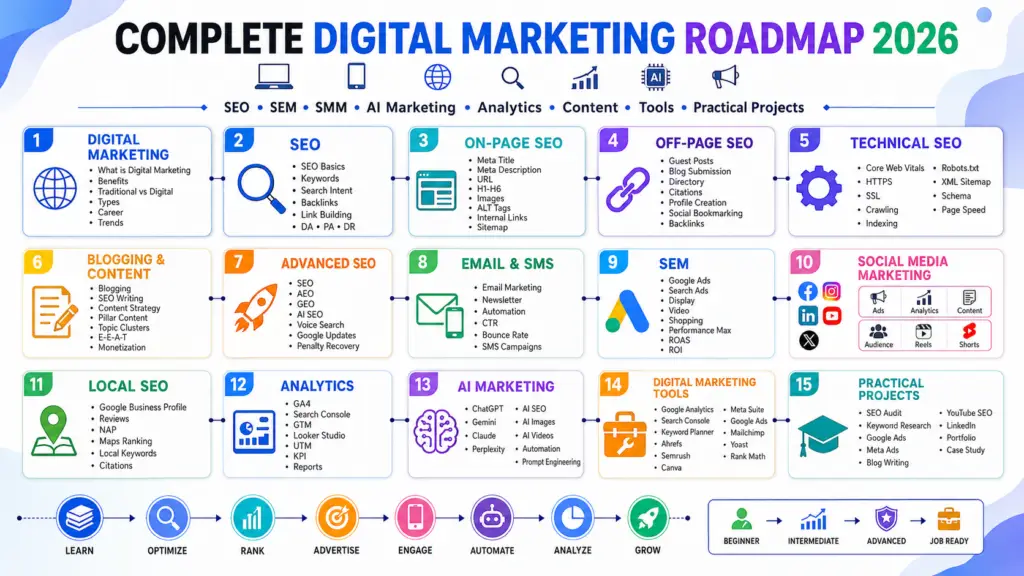
A clear plan keeps you focused in the vast online world. Follow the 2026 digital marketing roadmap to learn all the basics in order.
This digital marketing roadmap is a step-by-step guide for digital marketing beginners. It helps you track your progress and stay motivated.
How to study consistently with a limited weekly schedule
You don’t need to study for hours daily to make progress. Being consistent is more important than how much you study when you’re busy.
- Dedicate two hours every Saturday morning for deep learning.
- Spend 15 minutes each evening reviewing one specific concept.
- Use your commute to listen to industry-related podcasts.
Use free courses, trusted blogs and platform documentation carefully
The internet has many resources, but focus on official platform guides like Google and Meta. They are always up-to-date and accurate.
Also, use reputable industry blogs. Always check the information to make sure it’s current and correct.
| Skill Area | Primary Tool | Goal |
| SEO | Google Search Console | Improve visibility |
| Analytics | Google Analytics | Track performance |
| Content | Canva | Visual engagement |
How Beginners Can Build Experience and Get Their First Opportunity
Starting a career in digital marketing means showing what you can do for a business. Certifications are good, but employers want to see you in action. A clear digital marketing roadmap helps focus on the skills that matter most.
Create a simple portfolio website or professional profile
Your portfolio is like a digital shopfront. Make it clean and professional, whether on a website or LinkedIn. Include your best work, a brief bio, and how to contact you.
Build practical projects for an imaginary or local Indian business
Practice is key for digital marketing for beginners. Pick a local shop or create a fake brand to test your skills. This shows you can do the job.
SEO audit, content calendar, social campaign and paid advertising plan
To impress, create a detailed plan for your chosen business. This includes:
- Doing an SEO audit to find gaps.
- Creating a 30-day content calendar that meets business goals.
- Planning a social media campaign to increase engagement.
- Writing a paid advertising plan with a hypothetical budget.
Use a personal blog or social account as a testing ground
You don’t need a client to start. Use your blog or social media to track results. This helps you learn to interpret data and improve your strategies.
Present your work with objectives, actions, results and lessons
When applying for digital marketing jobs, use the OARL framework. Explain your goals, actions, results, and lessons. This shows you’re analytical and professional.
Find internships, volunteer projects and small-business opportunities
Start with small, unpaid roles. Contact local Indian businesses or non-profits for help. These roles build your resume and network.
Prepare for digital marketing interviews
Interviews are your chance to share your thought process. Be ready to talk about problem-solving and campaign choices. A good digital marketing career is about clear communication.
Questions about campaigns, metrics, tools and problem-solving
Interviewers will ask about your practical knowledge. They might ask how to improve ads or which metrics to track. Always focus on how your actions help the business grow.
Avoid common beginner mistakes when applying for jobs
Don’t apply without tailoring your resume. Make sure it matches the job description. Show how your experience fits the company, avoiding generic templates.
How AI Is Changing Digital Marketing and Advertising
Technology is always changing, and so should your digital marketing. Artificial intelligence is not taking over, but it’s changing the game. By learning these new tools, you can keep up with the fast pace of the market.
AI-assisted content research, drafting and personalisation
AI tools can do deep research and create drafts quickly. They help find trending topics and come up with creative ideas. AI also makes content personal, so it speaks to your audience better.
Automated bidding, audience targeting and creative testing
Google Ads and Meta use AI to improve your ads. Automated bidding saves your budget for the best results. AI also tests different ads to find the best one.
Predictive analytics, recommendations and customer segmentation
AI makes understanding data easier. It looks at past behaviour to predict future trends and suggest products. This helps you target your audience more accurately.
Why human strategy, editing and brand judgement remain essential
AI is powerful, but it can’t replace human touch. Your digital marketing skills in strategy and brand voice are key. AI gives data, but you need to add the vision and emotional connection.
Responsible use of AI, accuracy checks and customer privacy
Using AI means being ethical and protecting data. Make sure the data is safe and accurate. Always check AI’s work to avoid mistakes or biased content.
Reviewing generated content before publishing or using it in advertising
Always review AI content before sharing it. Check for facts, tone, and copyright. This step is crucial for your brand’s reputation.
Skills marketers should develop alongside AI tools
To succeed with AI, focus on certain digital marketing skills. These include:
- Critical thinking to evaluate AI outputs effectively.
- Data interpretation to turn raw numbers into actionable strategies.
- Ethical decision-making to navigate privacy and bias concerns.
- Advanced communication to refine and polish AI-assisted work.
Conclusion
Success in today’s digital world depends on linking customer needs with business goals. Digital marketing is a key tool that connects brands with their audience. It focuses on creating valuable content and offers that grow businesses.
Getting better at digital marketing is crucial for your career. You need to learn about analytics, content planning, and using different tools. These skills help you keep up with changing technology and what people want.
There are many jobs in digital marketing if you keep learning. You can work for a company, join an agency, or be a freelancer. Your success comes from showing you can solve real business challenges through your work.
Always think about data privacy and ethics as you grow in your career. Being open to trying new things and getting better is what matters. Start improving your digital marketing skills now. Look into the many job options in digital marketing across India.